
A comprehensive examination of material science, factory-floor engineering, supply chain resilience, and private-label customization for global combat sports brands.
The global combat sports and athletic training market is experiencing an unprecedented evolution. Brand owners, combat sports distributors, gym franchises, and e-commerce leaders are no longer merely looking for cheap suppliers; they require high-precision engineering, consistent textile performance, verified compliance, and flexible Minimum Order Quantities (MOQs). When evaluating China top training gear manufacturers and global OEM production hubs, international procurement teams must analyze the entire manufacturing ecosystem—from yarn extrusion and sublimation ink stability to hand-stitched leather assembly and multi-layer shock absorption systems.
As an industry leader with over 23 years of floor-level operational excellence, Sedate Group of Industries has established standard-setting benchmarks across both textile sublimated fight apparel and leather combat equipment. Synthesizing Chinese advanced synthetic fabric supply chains with Sialkot’s world-renowned artisanal stitching heritage, our dual-tier strategy gives global brands an unassailable competitive advantage in product durability, kinetic comfort, and aesthetic precision.
High-intensity combat disciplines—such as Mixed Martial Arts (MMA), Brazilian Jiu-Jitsu (BJJ), Muay Thai, Kickboxing, and Functional Cross-Training—impose extreme friction, moisture accumulation, and structural stress on apparel and protective equipment. Top-tier manufacturing relies on four fundamental engineering pillars:
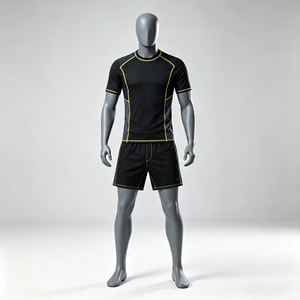
Constructed using high-grade Polyester-Elastane (typically 84% Polyester / 16% Spandex, 220–260 GSM), engineered to support muscle compression, facilitate thermal regulation, and prevent mat burns during grappling. Features flatlock 4-needle 6-thread seam reinforcement.
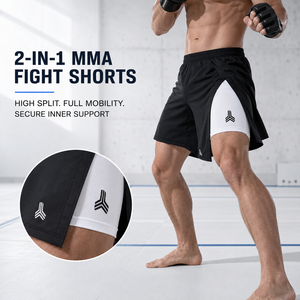
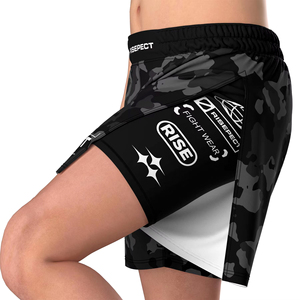
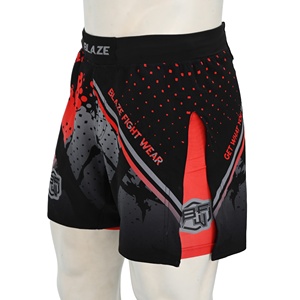
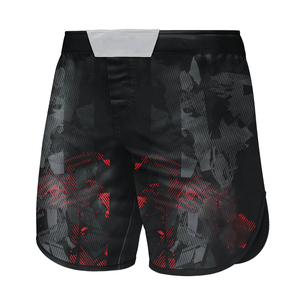
Integrating an ultra-lightweight outer shell (4-way stretch micro-polyester ripstop with lateral high-slits) with an embedded compression inner liner. This dual-layer construction guarantees maximum rotational range of motion during high kicks and ground transitions.
Injection Molded Foam (IMF) paired with latex layers and high-density EVA sheet matrixes. Designed to dissipate localized kinetic impact forces, protecting hand joints during heavy bag workouts and sparring.
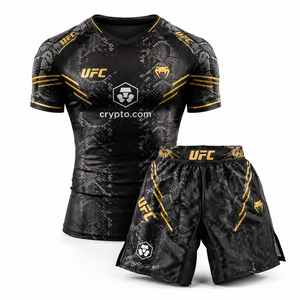
One of the primary failure points in commercial training gear is logo peeling, cracking, or color fading after repeated wash cycles. Leading Chinese and international factories utilize Italian fluorescent inks and high-pressure thermal sublimation transfer (at 210°C / 410°F). This process fuses pigment directly into the synthetic fiber matrix, ensuring vibrant prints, full breathability, and zero tactile stiffness.
As the international combat sports industry expands past $12 Billion globally, procurement managers must align with several macro trends transforming manufacturing workflows:
While premium cowhide leather remains favored for elite competition gloves, synthetic microfiber leathers (PU/PA matrices) are rapidly dominating the high-volume training sector. High-tier microfibers offer superior tear resistance, hydrostatic water resistance, anti-bacterial qualities, and lower carbon footprints compared to traditional tanning processes.
Brands no longer accept rigid 1,000-piece per style minimums. Modern manufacturing facilities utilize CAD digital pattern cutting and automated embroidery to offer pilot runs of 50 to 100 units per model, allowing brands to test market demand before committing to multi-container mass production.
Furthermore, Tech-Pack Driven Manufacturing has eliminated guesswork. International buyers now provide digital tech packs specifying flatlock stitch-per-inch (SPI: 8-10 stitches/inch), seam allowances, placement coordinates, fabric composition, and custom retail packaging specs.
To assist sourcing executives in auditing potential factory partners, the following comparative evaluation framework highlights the key differences between low-grade commercial suppliers and high-precision OEM manufacturers:
| Performance Vector | Standard Commercial Supplier | Sedate Group Tier-1 OEM Production |
|---|---|---|
| Primary Shell Fabric | 100% Basic Micro-Polyester (No Elastane) | Sublimation-Grade 4-Way Stretch Ripstop + Elastane Compression |
| Seam Strength & Stitching | Standard 2-Needle Overlock (Prone to popping) | Heavy-Duty Flatlock 4-Needle 6-Thread (Bonded Nylon Yarn) |
| Padding & Core Foams | Reconstituted / Recycled Scrap Foam Block | Multi-Layer Machine Molded IMF + Gel Core Shock Dispersion Matrix |
| Branding Application | Basic Screen Print (Fades & cracks within 10 washes) | Italian Gas-Phase Thermal Sublimation & 3D TPU Heat Transfer |
| Quality Control Protocol | Random End-of-Line Visual Checks | 5-Stage Inline QC (Cut, Stitch, Mold, Print, Pre-Shipment Inspection) |
| Sampling Lead Time | 20 to 30 Days (Vague tech pack handling) | 7 to 12 Working Days (CAD Pattern & Sealed Prototype System) |
Rooted in a rich industrial heritage spanning over two decades, Sedate Group of Industries represents the gold standard in OEM and private-label combat sports manufacturing. Our operations combine state-of-the-art textile processing with rigorous quality assurance:
We provide comprehensive branding eco-systems: custom woven neck tags, care labels, heat-seal size transfers, branded hang-tags, polybags with EAN/UPC barcoding, and retail-ready custom master cartons built to your brand manual.
Transform your concept sketches or reference samples into physical, battle-tested prototypes within 7 to 12 business days. Tech pack assistance and sample video verification ensure smooth pre-production approvals.
Below are detailed answers to key questions asked by international buyers when sourcing combat gear from China and global OEM leaders:
Our standard OEM pilot production runs start at 50 pairs/pieces per model and colorway for equipment like boxing gloves and fight shorts, and 100 pieces per style for custom sublimated apparel like rash guards and compression pants. Established brands and distributors can combine multiple product models within a single master purchase order to achieve high-volume tier pricing while optimizing inventory carrying costs.
Prototype samples are completed within 7 to 12 working days following digital tech pack and artwork sign-off. Bulk production averages approximately 45 calendar days from the moment the sealed sample is approved. Production schedules are transparently communicated with dedicated milestone updates during fabric cutting, stitching, branding, and final packaging.
We work with a versatile spectrum of materials tailored to your target price and performance requirements. Shell materials include premium full-grain cowhide leather, durable goat leather, ultra-light synthetic microfibers, and matte PU. Apparel units utilize 4-way stretch polyester-spandex, sublimated ripstop, mesh breathability panels, and 550gsm to 750gsm pearl-weave cotton for BJJ gis.
Every finalized project is backed by a locked Bill of Materials (BOM), digital CAD cutting templates, color-matched Pantone print profiles, and a physical sealed reference sample stored in our QA vault. Subsequent repeat orders are strictly measured against these golden samples to ensure zero variation in stitch density, sizing fit, padding weight, or color tone.
We offer flexible Incoterms including EXW, FOB, CFR, CIF, and DDP (Door Delivery Duty Paid). Our export department prepares all required shipping documentation, including Commercial Invoices, Packing Lists, Certificates of Origin (Form A/COO), and HS Code classifications for customs clearance across North America, Europe, Australia, and Asia.
Whether you are scaling an established martial arts label or launching a new fightwear line, our team delivers the technical engineering, strict quality control, and export capability your business demands.
Contact Us